Wednesday, 14 November 2018

Pre-production- 49 days on the street review


49 days on the street follows 18 year old Imogen after she's been kick out of the house by her mother. Over 49 days of living on the street Imogen documents her journey and mental health through user generated footage.


The documentary meets Imogen right after she's been told to leave, it uses user generated content from her own camera as well as the crews camera to document her as she goes from one friend's house to another. This makes the her more relatable to the audience as it further isolates her even from the crew when she is filming. the observational style of the crew's camera follows her through finding places to live, by giving her a camera to record herself they've allowed her to in a sense take control of the way the doc goes. 
Graphics in this doc assist the audience in knowing what's happened to Imogen when the cameras haven't been with her, helping them create a viewer relationship with her.

This doc hit BBC 3's remit, it's about an issue that affects a lot of young people and the lead contributor in the age demographic that they target. As the doc follows both her journey to finding a home and the affect it has on her mental health it's another theme that affects young people.

--------------------------------------------------------------------

I reviewed this documentary as it's a short form BBC three doc which is what ours aims to be.
From it I've learnt what is acceptable for BBC 3 content and what they are looming for. By using young people it's more relatable to their audience which is something our doc hopes to achieve and by using themes relevant in the audience's lives its further relatable to them. 
I also learnt that in a short form linear timeline things like graphics help fill gaps missed for the audience.

Pre-production: Scheduale


“When things don’t go like you planned, and in my experience, that has happened on every single film and in a way, I’m thankful for that because anytime I’ve had an idea for a film and then had the good fortune to make it, my ideas about what it was going to be, what came out at the end was better than I could have imagined,” (Indie Wire, When things don't go as planned)

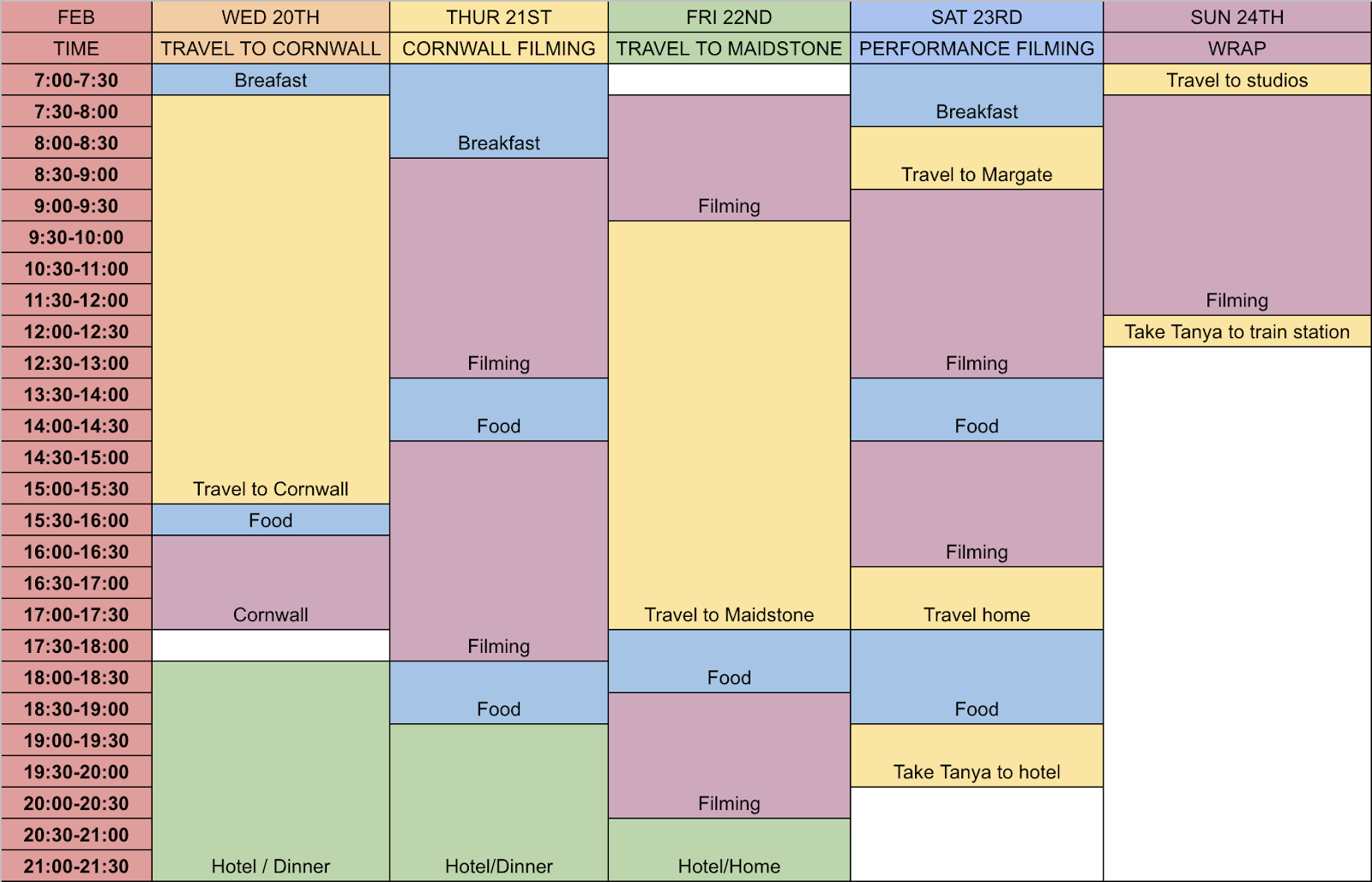
I created two different schedules one being a monthly one that had uni deadlines as well as deadlines I had set and other things for the doc, the other being the shooting schedule for the week in February that we are filming.
To help me come up with the format for the schedule I looked into other schedules online and took inspiration from that. 


(Example Production schedule for My Place My Space) 
From this I learnt that it's better to keep the schedule as simple as possible with only the details needed in it. It's also better to do it to as accurate times as possible this way you can see clearer if the schedule is being kept to.

Original filming schedule


After our pitch update Simon suggested extending the schedule so that we have longer to film and everything isn't as time pressured.


"Add 10% That applies to the number of days on the schedule and to the length of each individual day, because there’ll always be something that crops up: setting up or breaking down the set taking longer than expected, a sudden rain cloud halting production for half an hour, an actor wanting to experiment, or simply forgetting to budget time for lunch and breaks" - (New York Film Academy)
Revised filming schedule


The new schedule allows more time for filming and also lets us prepare any paper work needed for the next day and review what we'd like to shoot. I colour coded it so that it can be looked at with one glance and not confuse people.

Month Schedule

To ensure that crew are keeping to deadlines I created a monthly schedule that everyone could access and look at/update whenever they need to.


Revised schedule


After meeting with Helen and talking about the schedule I've moved around some times for logistical reasons and scheduled in lunches and dinners as you can't always guarantee you'll remember to do it.


I then had to alter the dates for filming as Tanya had something come up, so filming was brought forward.


For each day I've set out targets for things that need to be filmed, and times allotted for it.

Tuesday, 13 November 2018

Pre-production: Platform/Audience

"Rewerked' would be on Channel 4 as it fits with their remit of, standing up for diversity, being innovative and taking risks, as well as championing unheard voices (Channel 4 Remit). Although Drag is heard Zodi's Drag style isn't. - from our previous pitches"

Originally our previous pitches stated that we wanted "Rewerked" to be a Channel 4 production however after looking more into aired content from that channel I decided that this would no longer be the case.

Our target audience is 18-40 year old, men and women. We're targeting this demographic as they are less likely to know about the Drag community then others, as well as this genre of Drag is very popular with examples like RuPaul's Drag Race "with the show becoming the number one non-sports cable program among the coveted 18- to 49-year-old demographic" (Rupaul's made Drag mainstream, VICE) indicating an interest in the subject matter.

Knowing what our audience is and what we're setting out to achieve with it I looked into three other channel remits:

BBC 3

BBC Three is the BBC's online output for content targeted at 16-34 year olds. We back original voices and unique ideas to provoke reaction and stimulate emotion (BBC 3 commissioning.) Since going online on February 16th 2016 they've doubled their reach. Since moving online they've organised their content around two editorial pillars- 'Make me laugh' and 'Make me think'. Their remit has been expanded to included focusing on factual entertainment and entertainment formats.

BBC Three is a badge of quality - we pride ourselves with delivering content that has purpose, that stimulates emotions and provokes reactions.  BBC Three is Bold and Creative. On Three we are freed from the constraints of linear TV so no longer bound by time slot and can make content appropriate to the platform and the needs of the idea and our audience. (BBC 3 commissioning)
They publish their content where an audiences are most likely to find it, these include; BBC 3 website, Youtube, Facebook, Instagram, Twitter, Whatsapp, Snapchat and others. Most of these will be accessible globally.
These ideas come in a variety of forms:
  • We will commission one-offs that compliment seasons or long form programmes
  • We will commission pilots with a view to a longer run
  • We will commission strands exclusively for social media
  • We will commission compelling series of multi-platform shorts that can be stripped or serialised across platforms with clever scheduling and activation strategies around them
  • We are open to discussing form and volume and looking for the most innovative ideas with fresh and distinctive execution (BBC 3 commissioning)
------------------------------------------------------------------------

Our documentary would be suited to being aired on BBC 3, this is because they have content that is short form like our doc. It online presence means our target audience can be reached as an online video can be shared a lot more via social media. They specifically tailor where they post their content so that the target audience can see it.

ITV

The Factual Entertainment team commissions for ITV primetime and for ITV's digital channels. They look for premium, aspirational, optimistic, entertaining, dramatic, bold, exciting, big-hearted programming with broad appeal. (ITV Factual Drama commissioning)
The priority is the 9pm slot where the team are looking for a variety of ambitious, scaled-up and schedule bursting events, strips, access-docs, returnable series and singles. They're interested in privileged-access documentaries about well-known institutions, brands and individuals.
Big talent, diversity are really important to the team. They're not interested in niche subject matters and are keen to reinvent and innovate within the mainstream and within established genres like travel, crime, health etc.
The team welcomes pitches that speak to the priorities above and ask producers to consider how programmes will make the audience 'feel', as well as 'think'.

--------------------------------------------------------------------

Itv wouldn't be the best platform for our doc, our subject matter and format can't come back for a returning series. As our doc is about a niche topic like drag they won't be interested in commissioning it.

Channel 5

Channel 5 commissioners are looking for:

  • Returnable 8pm series', some access or lightly formatted in broad subject areas that reflect who we are and how we live. 
  • 10pm entertaining documentary series or one-offs.
  • Younger skewing entertaining ideas for the 10pm slot. Not necessarily studio based or your typical “shiny floor” show and not necessarily long runs. Could be an observational documentary or a soft format. Celebrity Wedding Planner, The Bachelor and Celebrity Super-Spa have all performed well in this slot. (Channel 5 commissioning)
  • A witty and intelligent talent-led passion project for 9pm.
  • Returnable documentary series.
  • Repetitional one-offs which reinforce our commitment with first class talent.
  • Presenter-led series which allows us to explore big ideas and new territories in a Channel 5 way such as ‘Secrets Of The National Trust with Alan Titchmarsh’ or Ruth and Eamonn’s upcoming series on marriage. (Channel 5 commissioning)
  • Intelligent, controversial and innovative series ideas which can punch above their weight in terms of reputation and ratings.
--------------------------------------------------------------------

Our doc could work for channel four due to their ability to adapt to what ever format it is in, how ever they are looking for a presenter-led series, as well as this they have had an increase in viewings from our target audience age, 4 per cent increase amongst 16-34s (Channel 5, revamp "The Drum")


Because I decided that our documentary would be aired on BBC 3 I looked into commissioning guidelines that would help us along the way of filming. The responsibility for commissioning the majority of independent network television programmes rests with BBC Television. It commissions programmes both from in-house producers and from independent producers.(BBC Code of Practice)

we are also interested in singles with a distinctive voice or personal story at their heart.  We get lots of singles pitched and the best demonstrate a clear directorial vision, genuine passion for their story and have a real purpose. These could be authored by the director or feature new onscreen talent but we need distinctive pieces that provoke and challenge our audience and feel genuine to them (they can smell inauthenticity from a mile away).
We’ll work closely with the channel to develop new talent through short-form commissions. We want new voices that take us into the heart of surprising territories and stories. We’ll be talking to you about short-form that could accompany longform commissions.
We want to focus on domestic issues that dominate young minds - work, drugs and alcohol, relationships, identity... how can we reflect their experiences? 
We want brave and ambitious access allied to a strong sense of what it is the director wants to discover/explore/reveal. Life and Death Row and Love and Hate Crime continue to bring large audiences to question the issues of justice, retribution and punishment. Where are the next access pieces that take the audience into challenging stories which question our ethical assumptions? (BBC 3 commissioning)

Our subject matter is one that BBC 3 would want because, it is a new and generally unheard voice of a subject that has been mainstream for many years. It follows a personal story with an important message behind it of acceptance and understanding, it causes audience's to question what they know as well as enquire about it. These are issues that are around for young people as it's these young people breaking and pushing the boundaries.


Over all from this I have learnt the importance of needing to read the remit so that you can both ensure you are making the programme you want, but also fits in with codes and regulations from the channel.

Preproduction: Pitch updates


Today we presented our project updates to the class.


General notes taken during other presentations:


  • Check BBC weather before any shoots and for updates regularly on weather changes
  • Use spreadsheet formulas in budgets etc for accurate calculations
Feedback from Simon about our presentation:

  • Look at UCA Canterbury for a theatre area
  • Look at Tom Thumb Theatre in Margate
  • Look into the schedule and consider making it 5-6 days instead of 3 days long
  • Research is good and at an advanced level
  • Where does the story resolve? either through interviews with contribs or at the end of filming
  • We need more script drafts
--------------------------------------------------------------------

From this feedback I will now;

Rethink the schedule and how I can make it longer and therefore more efficient. Look at and contact people about locations for filming.


pre-production review: Bi-Curious me


Bi-Curious me is a documentary film that follows three women coming to terms with changes in their sexuality and exploring same-sex relationships. It follows multiple stories of women who are either experimenting with their sexuality or how they live as bisexual. The doc interviews families and friends of the contributors too.


Bi-curious me is a stand alone film made by the production company Rare Day. The film aired on Channel 4 and received mixed reviews:
No amount of shimmying burlesque dancers, however, could liven up what was essentially dull television. The programme followed three women who were exploring same-sex relationships, with most of the focus on a beautiful young woman torn between a boyfriend, a girlfriend, and a life of untrammelled sexual adventure. Did she love the boyfriend? Did he love her? Would she go home with the girl in the bar? Would I stay awake long enough to find out?
Moving documentaries can be woven from the complex fibres of modern relationships – as anything from BBC Two’s Wonderland series testifies – but this was not one of them. The only real stab of sympathy I felt was for a man called Andrew. Not only did his wife leave him after 22 years of marriage, but he also received a damp, gravel-filled sock to the jaw in the form of her announcement on national TV that she preferred sleeping with women to men. - Ceri Radford

Despite reviews like this the film was one of channel 4's more diverse outputs covering sexuality, following a year of being one of the more diverse channels in 2012, 2013 saw Channel 4 eager to do the same.
However as the documentary only focuses on a few female bisexual people, it has a one-sided and further limited opinion/experience of bisexuality. Some of the interviewees are symbolising old stereotypes, for example one women dates a lot of different people. This is following the myth that bisexual people sleep around a lot. There isn't a bisexual man included or someone who is in a stable relationship either.


The film is suited to be aired on Channel 4 as it meets with the Channels remit specifically showing 'alternative views', being 'educational' and 'invest in high quality content'.
Locations for this doc include Burlesque bars, Strip clubs as well as the homes of contributors. All locations bar a few are in the Uk the others are in America and France. Within these locations the doc has great access to people who are just discovering their sexualities and others who have been living as Bisexual for years. One such women came out as Bi after having an affair with another women, the doc interviews both her and her husband of 22 years. I asked questions to the producer of Bi curious me, specifically how to find contributors and build trust with them.
How do you find contributors and then keep them on board with the project for a long period of time? Do you have any advice on building trust with contributors?

Huge question! Depends on the project. We go through charities, government organisations, hospital trusts, online forums. It's important always to be honest, open, a friend to them if they need it, and being available to take calls at any time. It's being respectful of what they are going through and being as supportive as you can, without being intrusive. It's a privilege to be able to film someone and we never forget that.

--------------------------------------------------------------------------

Overall from this I have learnt a lot about bisexuality, it's often something that is overlooked in media and documentaries however through both watching this doc and reading reviews for it I've come to learn more then I already knew. From this I've also learnt that this documentary also represents two oppositions of bisexuality and while that is ok, it's important to acknowledge that not all bisexual/any one involved in a documentary about one subject, are the same.

From here I will use this research in my pre-production by trying to find a variety of locations that assist the story telling aspect of our documentary, each location in bi-curious me has a purpose and significance to the interviewee and that's something I'm keen to replicate. I will also be sure to keep in contact with contributors we have as they are sharing personal information about themselves with us they are likely to be unsure about filming, I'll have consistent communication for reassurance towards them.

Sunday, 11 November 2018

Pre-production- Review The Boy Who Was Born a Girl- Real Stories


The Boy Who Was Born a Girl is a documentary about 16 year old Jon who lives in the south of England, he's was born a girl how ever after suffering from gender dysphoria for years the documentary follows him on his journey becoming a man.


In terms of access the doc has access to Jon's house allowing them to become apart of his life, they also go with him to Doctor appointments. This allows the audience to become apart of the journey for Jon and through that become educated about being trans. The use of archive footage/photos of Jon as a child are also important as he is able to share his opinions about his mother's struggle calling him a boy.
It also sees Jon go to support meetings and interviews members of those meeting.

Interviews either range from being conversations between Jon and his mother to set up constructed conversations with the camera. These interviews with the camera also show what it's like for Jon's mum to have a trans son and how she is transitioning from having Natasha to having Jon.

The conversations allow it to loose some form of formality and become relatable to the audience, while pieces to camera are where the audience can learn about thoughts, feelings and opinions. The documentary takes Jon into a constructed photo shoot were he can be as masculine as he wants, this is similar to our documentary as we are constructing a show for Tanya to perform in. It sees Jon go through big phases of being trans in buying binders, talking about having a mastectomy, and finally ending with his first day of school as a boy.

--------------------------------------------------------------------

Overall from this Documentary I learnt:
  • It's reaffirmed the idea that the more educated we are about the topic we are filming the less likely we are to upset contributors, in this doc Jon gets upset with his mum that she is calling him and girl. We'd avoid this by sending research questions to contributors asking if they have any preferred pro-nouns or anything they'd like us to take note of.
  • As filmmakers it's important to remember that this is a major life event, in our case it's a big thing for Tanya to perform with other Drag Queens while in this case it's a big thing for Jon to go to school as a boy. This needs to be remembered as emotions can run high, this would be calmed by constant communication and reassurance.

Tuesday, 6 November 2018

Pre-production: Budget


Budget

For our project 'Rewerked' we all contributed £500 at the beginning of production, this would be to cover food, travel, accommodation, kit and any other unexpected expenses. This money would then be put into a bank account that I had access to and could track the progress online and via a spread sheet to ensure that money was being spent correctly. Your film’s budget isn’t aspirational. It should encompass everything you will actually spend on the film, not what you hope to spend. With this in mind, envision each step along the way and the coinciding costs. Initially, with the goal of spending as little as possible (10 Lessons Learned While Making My First Short Film Budget)

Some major factors that can affect the cost of a documentary are;

Shooting costs


Shooting can incur many hidden costs including, kit, crew, locations, talent and any graphics you want in the doc. For our shoot the kit we need to pay for 2 cameras and that's is due to our DOP already the rest of the kit he wants. Our crew is all students and instead of being paid a wage their travel would be covered, any location that needed to be paid for would be negotiated to keep things as low as they possibly can be. Our talent will not be getting paid and they are all aware of this, instead their travel and food will be paid for like the crew. 
Any graphics done would be done by students so again would not be getting paid for. Because of this we have saved a lot of money compared to what would have been spent. After sitting down with Gavin the DOP and discussing the kit he would have liked we came to a conclusion that we were both happy with, where we got cheap cameras that would give the image quality he needed. do you HAVE to have original underwater footage that you capture in far-off waters, or can you get by with licensing some stunning underwater footage from a stock house? (How to create an accurate documentary budget)


Distribution and marketing


After spending a bunch of money to make your film, it deserves to have strong marketing materials to go with it. A good website, postcards, a well-designed poster will cost money (not necessarily a lot) but they will help you create a cohesive visual identity for your film, making it more accessible to festival programmer and eventually an audience. (10 Lessons Learned While Making My First Short Film Budget)
Instead of paying for our marketing I got in contact with someone I know who does graphic design to make our poster, we went to Tanya and took photos and then briefed the person on what we wanted.
For social media I created a facebook page and instagram that allows us to share our project with a lot of other people


Format


For help with how to format the budget I looked into examples and found this one from Sundance:


The format for our budget is on 2 different spread sheets one with the estimated cost in it and the other with the actual cost of things so I can see if we were staying on track with what we should be spending. This is what we had.


Actual costs so far look like this:


I then had a meeting with Helen to ask her for help on anything I'm either missing or anything where I'm spending money on something I shouldn't be. She noted that we shouldn't be spending as much on accommodation and travel where we could be saving with car rides instead of trains. She also suggested I give a lot more money for food.


This is the final version of the budget that also includes Graphics, Props and Music, even though we're not anticipating any money being spent on them they're included incase any unexpected costs arise.
-----------------------------------------------------------------------------------
What I learnt from doing the budget is the importance of having contingency money incase anything costs more than it does. I've learnt the importance of having it in as simple of a format as I possibly could so that everyone can understand and see where the money is going. I've also learnt the need to compromise with members of crew on certain things, for example if Gavin wanted another camera or Jemma wanted a location we couldn't afford or get for free, I'd have to sit down with them and work out a way where we can still get good footage for a cheap price. 

Production: Role research

To better understand my crew's roles and how I fit in with how they are working I did research into all four roles and what they do dur...